Context: Health professions education (HPE) scholarship is expanding but remains unevenly distributed by region and language. Scientometrics can guide efforts to strengthen bibliodiversity, particularly for Global South regions underrepresented in HPE meta-research.
Objectives: This study aims to characterise publications from Hispanic America across medicine, nursing, dentistry and veterinary medicine, examining productivity, venues, collaboration, gender and thematic evolution.
Methods: We analysed HPE journal articles (1992–2025) indexed in PubMed, Scopus and SciELO Citation Index (Web of Science), requiring ≥1 Hispanic American author affiliation. Records were merged, deduplicated and curated, and then analysed in Bibliometrix/Biblioshiny (Bradford concentration, author productivity, networks). Author gender was inferred from names using gender-guesser.
Results: We retrieved 3608 publications (annual growth 7.8%) authored by 11 240 individuals from 1563 institutions and published in 796 journals. [Correction added on 20 August 2026, after the first online publication: the preceding sentence has been corrected.] Medicine accounted for most articles (n = 2182), followed by nursing (n = 637), dentistry (n = 318), veterinary medicine (n = 68) and mixed health sciences (n = 403). The year 2023 was most productive (319 articles). Four hundred thirty-seven papers were single-authored. Author productivity was long-tailed (83.4% published once; 1.2% published >5 articles). International co-authorship was 17.2%; collaboration formed cohesive clusters with limited bridging. Publishing was concentrated: 15 core journals (1.9%) produced 34% of articles. Chile, Mexico, Peru, Colombia and Cuba led the output. Two thousand three hundred and six (64%) were in Spanish, 1260 (34.9%) in English, and 42 (1.1%) in both. Gender was near balanced (female 50.7%, male 47.3%; 0.35% androgynous and 1.7% unclassified), but women were underrepresented among the most prolific authors. Keywords emphasised teaching/learning and curricula/assessment, with post-2020 prominence of mental health and distance education/simulation training.
Conclusions: HPE scholarship in Hispanic America is growing, but expansion is occurring within an ecosystem marked by concentration and uneven connectivity (‘growth with fragility’) and centre-periphery dynamics in scholarly communication.
Recognising multilingual evidence and investing in bibliodiversity through bilingual dissemination/metadata, open identifiers and equitable collaboration can broaden the evidence base and support educational impact.
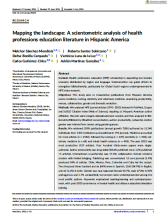
Sánchez-Mendiola M, Santos Solórzano R, Bonilla Cerquedo D, Luna de la Luz V, Gutiérrez-Cirlos C, Martínez González A. Mapping the landscape: A scientometric analysis of health professions education literature in Hispanic America. Med Educ. 2026;1-10. doi:10.1111/medu.70273.
García Dieguez M. Comment on the Mapping the landscape: A scientometric analysis of health professions education literature in Hispanic America. [Internet]. Pan American Health Organization. Bibliographic Repository. Available at: https://campus.paho.org/en/repo/mapping-landscape-scientometric-analysis-health-professions-education-literature-hispanic
García Dieguez M.
CEEProS Universidad Nacional del Sur
This article is essential reading for researchers and leaders involved in health professions education programs in Latin America. Through a bibliometric analysis of more than three decades of publications from Hispanic America, it provides a comprehensive overview of who is conducting research, where they publish, how they collaborate, and which topics are shaping the field. Beyond describing scientific productivity, the study encourages reflection on bibliodiversity, language barriers, and the structural inequalities that influence the international visibility of regional scholarship. Its findings are particularly relevant for researchers, journal editors, science policy makers, and academic leaders.
The study analyzed 3,598 publications in health professions education produced between 1992 and 2025, identified through PubMed, Scopus, and SciELO, making it one of the largest bibliometric analyses of Hispanic American scholarship in this field. Scientific output showed a sustained annual growth rate of 7.8%, although production remained concentrated in medicine, followed by nursing, dentistry, and veterinary medicine. Chile, Mexico, Peru, Colombia, and Cuba led regional productivity, while 64% of the articles were published in Spanish and 35% in English, reflecting a predominantly Spanish-speaking scholarly ecosystem. The findings indicate that regional scholarship follows a pattern of "growth with fragility": publication output continues to increase, but remains concentrated in a limited number of countries, institutions, and journals. Only 15 journals (1.9%) account for 34% of all publications, most authors publish only once, and international collaboration reaches only 17.2%. The thematic analysis also shows a shift from traditional topics such as curriculum, teaching, and assessment toward mental health, burnout, simulation, distance education, and the COVID-19 pandemic. The article introduces important concepts such as bibliodiversity, centre-periphery dynamics, and epistemic injustice, arguing that much Latin American scholarship remains insufficiently visible because of language barriers and international indexing systems.
From a methodological perspective, this is a robust bibliometric study. However, the authors acknowledge important limitations, including the exclusion of grey literature, books, and conference proceedings, the lack of methodological classification of the included studies, and the exclusion of Brazil, Spain, and Portugal. Consequently, the findings should not be considered representative of all Ibero-America.
- Publish simultaneously in Spanish and English (title, abstract, and keywords) to improve international visibility while preserving regional identity.
- Promote Latin American multicenter research networks to strengthen international collaboration and sustained scholarly productivity.
- Strengthen regional journals through bilingual metadata, DOI assignment, ORCID implementation, and indexing in international databases.
- Develop institutional mentoring programs, educational research training, and protected academic time to support scholarly production.
- Include regional databases such as SciELO in systematic reviews and literature searches to reduce bias toward English-language publications.
- Evaluate scientific productivity while considering linguistic and contextual diversity rather than relying exclusively on traditional bibliometric indicators.