Virtual learning and professional development
| Mapping the landscape: A scientometric analysis of health professions education literature in Hispanic America Context: Health professions education (HPE) scholarship is expanding but remains unevenly distributed by region and language. Scientometrics can guide efforts to strengthen bibliodiversity, particularly for Global South regions underrepresented in HPE meta-research. Objectives: This study aims to characterise publications from Hispanic America across medicine, nursing, dentistry and veterinary medicine, examining productivity, venues, collaboration, gender and thematic evolution. |
|
| Virtual training: Can remote clinical supervision be as effective as in-person supervision? Objectives: The COVID-19 pandemic led to a rapid adoption of telehealth technologies, particularly in terms of treatment delivery and trainee education. Prior work has found that virtual training (in which supervisors and trainees are not co-located and interact via virtual communication platforms) is well-received and supports effective supervisor/ trainee working relationships. However, there is limited assessment of the effectiveness of virtual training in supporting clinical skill development or working relationships. |
|
| Are Our Faculty Truly Digitally Competent? Choosing the Right Tools to Measure What Matters |
|
| Crossing the Virtual Chasm: Practical Considerations for Rethinking Curriculum, Competency, and Culture in the Virtual Care Era Virtual care, introduced previously as a replacement for in-person visits, is now being integrated into clinical care delivery models to complement in-person visits. The COVID-19 pandemic sped up this process. The rapid uptake of virtual care at the start of the pandemic prevented educators from taking deliberate steps to design the foundational elements of the related learning environment, including workflow, competencies, and assessment methods. |
|
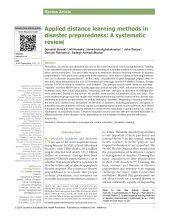
| Applied distance learning methods in disaster preparedness: A systematic review Nowadays, accidents and disasters are one of the most important issues facing humans. Training is an important feature in disasters and distance learning is a suitable method for education in every place and at every time. The aim of this study is to determine distance learning methods in disaster preparedness. This study was conducted to this question: what types of distance learning methods can use in disaster preparedness?”. |
|