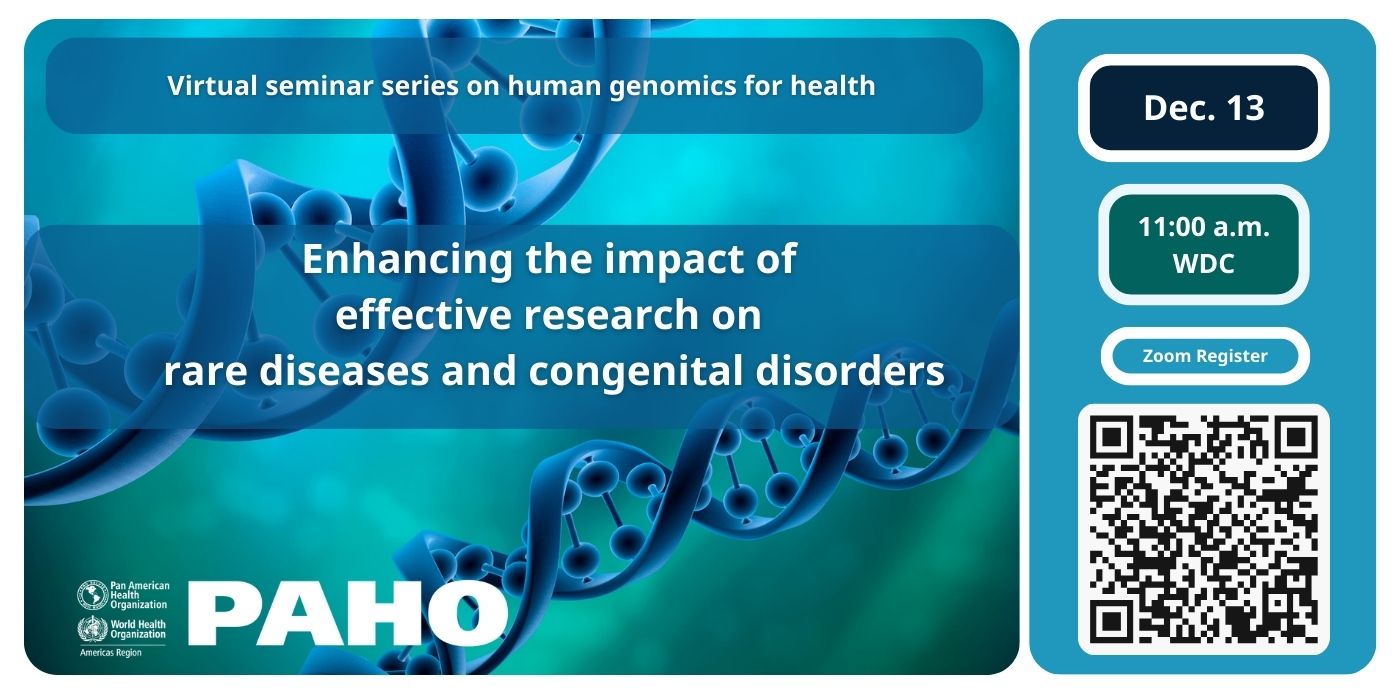
Virtual seminar series on human genomics for health
The Science and Knowledge for Impact Unit (SK/EIH) and the Latin American Center for Perinatology, Women's and Reproductive Health (CLP/WR) of PAHO invite you to participate in these series of virtual seminars on topics related to human genomics for health.
This first session was focused on engaging stakeholders across the Americas to enhance the impact of effective research on rare diseases and congenital disorders.
The webinar was held on Friday, December 13, 2024 and English - Spanish translation was available.
To engage stakeholders across the Americas to enhance the impact of effective research on rare diseases and congenital disorders.
Panelists, moderators and topics
- Ludovic Reveiz - Unit Chief, Science and Knowledge for Impact (SK/EIH), PAHO.
- Pablo Durán, Advisor, Perinatal Health, Center Director, CLAP.
Report of the PAHO meeting on human genomics
Dr. Gabriela Repetto (Chile), Member of the Technical Advisory Group on Genomics (TAG-G/WHO)
Genome sequencing for diagnosing rare diseases
Dr. Natan Monsores de Sá (Brazil), General Coordinator for Rare Diseases at the Brazilian Ministry of Health.
ECLAMC: The Latin-American collaborative study of congenital malformations
Dr. Ignacio Zarante (Colombia), Member of the Latin American Collaborative Study of Congenital Malformations (ECLAMC)
The new LatinOMICS initiative
Dr. José Elías García Ortiz (Mexico), President of the Latin American Network of Human Genetics (RELAGH)
Discussion (Q&A)
Moderators
- Dr. Iscia Lopes-Cendes, Chair and member of the Technical Advisory Group on Genomics (TAG-G/WHO)
- Dr. Sherry Taylor, Member of the Technical Advisory Group on Genomics (TAG-G/WHO)